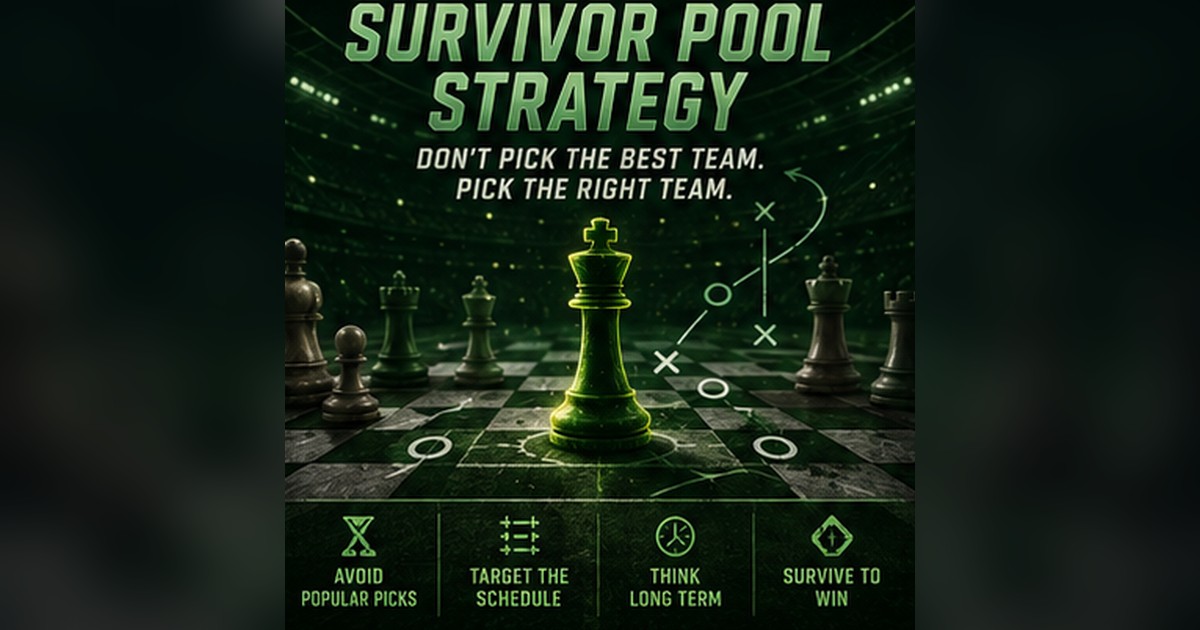
Key takeaways
- Teams are a budget, not a menu — using an elite team in week 2 means not having it in week 11 when nothing else is safe.
- Win probability isn't the only number: future value and pool popularity matter just as much.
- September is the graveyard. Play it boring early; the upsets will thin the pool for you.
- In big pools, differentiate. Surviving alongside 80% of the field barely moves you closer to the money.
Survivor looks like the simplest game in football: pick one team to win, any team, no point spreads. Then week three arrives, half your pool is dead, and the survivors all seem to know something you don't. They do — and it isn't football knowledge. It's resource management.
Your teams are a budget, not a menu
The once-per-season rule is the entire game. Every week you're not just asking "who wins?" — you're asking "what does this pick cost me later?" An elite team at home against a doormat is worth more in a future week where every matchup is a coin flip. Spend a mid-tier team on a comfortable spot now, and save your aces for the schedule's dead zones.
Week 3 casualties picked the best team. Week 14 survivors picked the right one.
The three numbers that matter
Win probability — obvious, and still the anchor. Never take a genuinely shaky team just to be cute.
Future value — scan the whole season's schedule before week one and mark where each strong team has its safest spots. If a team's best matchup is this week, that lowers the cost of using them now.
Pool popularity — the sneaky one. If 60% of your pool is on one team, that pick can't separate you from the field. If the chalk wins, everyone advances together; if it loses, the pool detonates. In bigger pools, a slightly riskier but unpopular pick is often the mathematically better play.
The classic blunder: burning your two best teams in the first three weeks because the matchups were juicy. Congratulations — you're now picking road favorites in November with everyone else's leftovers.
Respect the September graveyard
Early-season NFL is chaos: the public's team ratings are a year stale, and upsets cluster in weeks two through five. This is when boring picks shine. You don't win a survivor pool in September — you can only lose it. The same early-season mispricing that creates draft-day value creates survivor landmines.
Small pool vs. big pool: in a 10-person pool, just survive — take the safest pick every week. In a 500-person pool, differentiation wins: you need the field to die, not just yourself to live.
The pick'em angle
Everything here transfers to confidence pools: your confidence points are the same budget problem in miniature. The discipline of asking "what does this pick cost me if I'm wrong?" is the shared skill — and it's exactly what separates season-long winners from week-one hot streaks.
The bottom line
Survivor rewards the player who thinks two months ahead in a game everyone else plays one week at a time. Budget your teams, respect the early chaos, and in a big pool, dare to be a little different.
Ready to put a season of decisions on the line one Sunday at a time? That's literally the game.