Key takeaways
- This league only requires two starting running backs, so paying a premium for RB depth is a structural mistake. Three REC_FLEX spots absorb almost all of your remaining lineup value, and a bench RB3 or RB4 rarely sees the field here.
- The true RB1 tier is short: Bijan Robinson and Jahmyr Gibbs, then a real gap. Everyone from Christian McCaffrey on down is a clear step behind the top two.
- Four offseason moves reshaped backfields you need to know before you draft: Kenneth Walker III to Kansas City, Isiah Pacheco to Detroit, David Montgomery to Houston, and Travis Etienne to New Orleans.
- In full PPR, a target is worth roughly 2.5x what a carry is worth. Christian McCaffrey caught 102 passes last year, more than 25% ahead of the next-closest back — that's the receiving-back angle this format rewards.
- Derrick Henry and Kyren Williams sit lower on the expert tier list than their mock ADP suggests. Know which number you're actually drafting off of.
The running back position is always the loudest room at the draft table, and 2026 is no different. But before you let that noise talk you into a fourth running back in round six, remember what your lineup actually needs: QB / RB / RB / REC_FLEX x3 / K / DEF. Two running back starters. Three flex spots that, in full PPR, are going to be filled by receivers and pass-catching backs far more often than a third pure runner.
That single format detail should change how you build your RB tiers for this specific league. Below is the position broken into tiers using FantasyPros' expert consensus rank as the backbone, the offseason moves that reshuffled a handful of backfields, and the PPR math that explains why some names on this list are worth more than their touch count suggests — and why others, like Derrick Henry, are worth less than their mock ADP suggests.
The 2026 RB Tiers
Here's the position, tiered off the expert consensus top 15 plus the names just behind it.
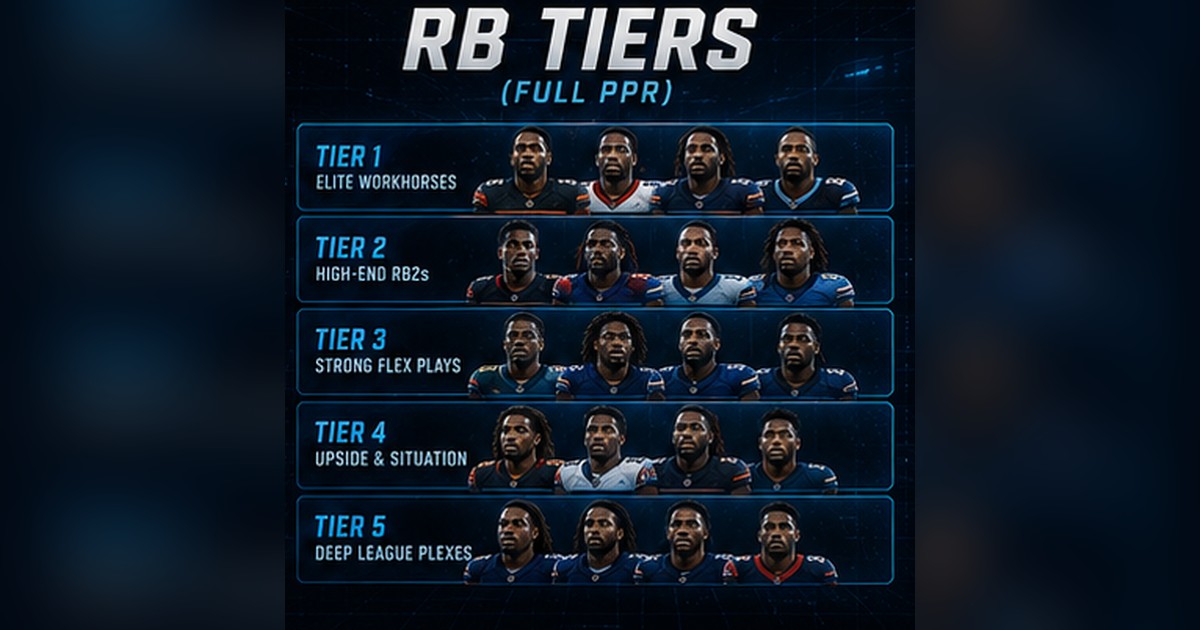
Tier 1 — the true bell cows: RB1 Bijan Robinson (ATL), RB2 Jahmyr Gibbs (DET). Both are going 1-2 overall in live full-PPR mock ADP, not just at the position — Bijan at 1.6, Gibbs at 1.7. Nobody else at the position is in this range.
Tier 2 — the clear-cut starters with real ceiling: RB3 Christian McCaffrey (SF), RB4 Jonathan Taylor (IND), RB5 Ashton Jeanty (LV). All three carry workhorse-or-close-to-it roles.
Tier 3 — good starters with a question attached: RB6 James Cook III (BUF), RB7 De'Von Achane (MIA), RB8 Chase Brown (CIN), RB9 Omarion Hampton (LAC), RB10 Saquon Barkley (PHI). This is the tier where the touch competition, offensive line, or passing-game role isn't quite as settled as the top five.
Tier 4 — the RB2/flex range with real variance: RB11 Kenneth Walker III (KC), RB12 Jeremiyah Love (ARI, rookie), RB13 Derrick Henry (BAL), RB14 Breece Hall (NYJ), RB15 Kyren Williams (LAR).
Just outside the top 15: Josh Jacobs (GB), Javonte Williams (DAL), Travis Etienne (NO), Cam Skattebo (NYG), Bucky Irving (TB), TreVeyon Henderson (NE), Quinshon Judkins (CLE), D'Andre Swift (CHI), David Montgomery (HOU), Bhayshul Tuten (JAX), and Jaylen Warren (PIT). That group is deep enough, and close enough together, that it's really one long RB2/handcuff tier rather than a strict ranking.
Four Offseason Moves That Reshaped the Position
Running back value doesn't just come from talent — it comes from who's standing next to you in the backfield. Four moves this offseason changed that math meaningfully.
- Kenneth Walker III, Seattle to Kansas City. Walker signed the richest running back free-agent deal in league history, one month after winning Super Bowl MVP with Seattle. He's walking into a brand-new offense as the RB11-tier piece, going 22.5 in mock ADP — earlier than his expert rank, which tells you the market likes the landing spot more than the panel does.
- Isiah Pacheco, Kansas City to Detroit. This is the move that actually clarifies things elsewhere: it locks Jahmyr Gibbs in as Detroit's unquestioned lead back rather than creating a real timeshare. Pacheco himself takes a meaningful PPR value hit in the move (-19.6), which tells you where the Lions expect him to line up in the pecking order.
- David Montgomery, Detroit to Houston. Montgomery lands in a Houston backfield that also added Woody Marks, whose PPR value jumped +15.0 this offseason on the strength of receiving work. That's an unsettled committee worth tracking, not assuming, heading into your draft.
- Travis Etienne, Jacksonville to New Orleans. A change of scenery for a back who's shown he can be a three-down player when the touches are there. He sits just outside the top-15 tier for now, which in a receiving-friendly format makes him a name worth checking on draft day rather than penciling in.
Why Only Needing Two RB Starters Changes Everything
Remember the exploitable pattern from live drafts this year: ESPN's drafters are taking running backs four to ten picks earlier than mock drafters, and pushing receivers ten to twenty-five picks later than the market elsewhere. That's a fine strategy in a league that starts three running backs. It's a mistake in this one.
You only have two mandatory RB slots. Every running back you draft after your first two starters is competing for a bench spot or, at best, one of three REC_FLEX spots against a much deeper receiver pool. A running back needs real receiving volume to be worth a flex start here — a 15-touch, two-target early-down back is a bench stash, not a flex play, no matter how good his per-carry numbers look.
In a league that only starts two running backs, your third and fourth backs aren't insurance against a bad RB1 — they're a bet that a bench player outscores the receiver you could have had in the same draft slot. That's a bet you lose more often than you'd think.
Do the arithmetic on your own bench: six bench spots, fourteen total rounds. If you spend four of your first eight picks on running backs beyond your top two, you've committed half your active bench to a position that starts two players, while the position that starts three — wide receiver — gets whatever's left. That's backwards for this specific format.
The PPR Receiving-Back Math
Here's the framing stat worth keeping in your head on draft day: a target is worth roughly 2.5 times what a carry is worth in full PPR scoring. Christian McCaffrey caught 102 passes last year, more than 25% ahead of the next-closest running back — and that receiving work is a huge part of why he's a locked-in Tier 2 back rather than just a good runner.
That math is exactly why some names on this board are worth more than their raw touch count suggests, and why others are worth less. On the plus side: backs like Kenny Gainwell (TB) and Rachaad White (WAS) posted some of the largest PPR value gains at the position this offseason on the strength of receiving roles, and Woody Marks (HOU) isn't far behind. None of them need to be a workhorse to matter in this league — they need targets.
On the minus side, that's the same reason early-down grinders without receiving work take a real hit here. Pacheco's -19.6 PPR value swing after landing behind Gibbs in Detroit is the clearest example, but Kyren Williams (-8.8) shows up on the loser list too, which is worth remembering given he's still going in the RB15 tier range by expert consensus.
When you're comparing two similarly-ranked backs late in your draft, ask which one is more likely to be on the field on third down. In this scoring system, that question matters more than which one is the clearer early-down starter.
What Six Seasons of ITFFL Drafts Say About Running Backs
This league's own draft history backs up the tier structure above better than almost any outside ranking could. Running back has always been the round-1-and-2 position here — 74 RB picks against 57 WR picks across six years — which tracks with taking Bijan or Gibbs the moment your pick comes up in the top tier. But that appetite doesn't last: round 3 flips hard, 38 receivers taken against just 19 backs, and the position mix stays receiver-heavy for most of the rounds that follow. Across all 1,080 picks in league history, receivers still outpace backs overall, 408 to 338.
That flip is the format argument in miniature. This league's managers have already been living the two-RB-slot, receiver-heavy roster reality for six years, even before this year's rules made it official — they just didn't always know why round 3 kept going to receivers. Now you do: once the top tier of true workhorse backs is off the board, the value shifts to whichever position still has bodies left to fill three flex spots, and that's receivers almost every year.
The takeaway for your RB tiers specifically: don't be surprised when the room's running back appetite disappears right around pick 25-30. That's not this year's format kicking in for the first time. That's six years of the same pattern playing out again.
The Pick'em Angle
The discipline here is the same one that wins weekly pick'em pools: don't pay for what everyone already believes. A running back run in rounds three and four feels safe because the room is doing it together, the same way chalk picks feel safe because everyone's making them. The value is always on the other side of that crowd behavior. Check where the position actually sits relative to receivers on our first-round board, cross-reference the wider PPR value shifts on our gainers-and-losers breakdown, and once the season starts, track how these backfields actually shake out on our statistics page before you set your next lineup.
Running back tiers will keep shifting a little between now and August 29 as backfield competitions sort themselves out in camp, especially in Houston and behind Kenneth Walker in Kansas City. But the format lens won't change: this league starts two running backs and three flex receivers, and your draft board should look like that math, not like a standard league's.