Key takeaways
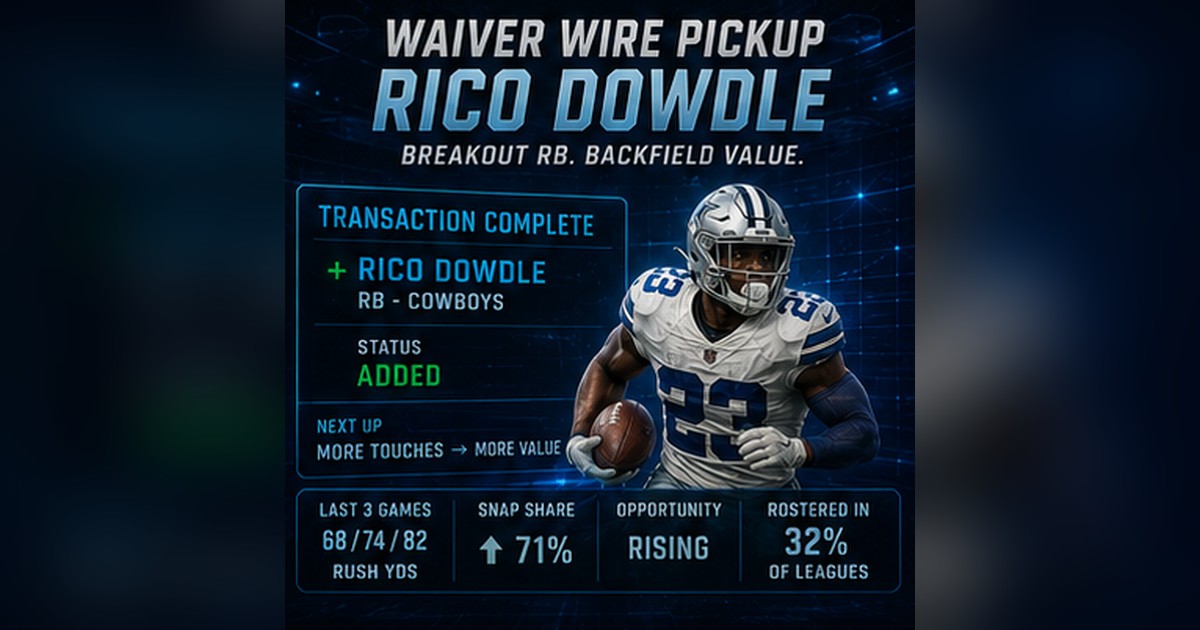
- The Rico Dowdle waiver wire run is the story of October so far. Back-to-back 30-plus point weeks in Weeks 5 and 6 turned a free bench flier into a back nobody is comfortable sitting.
- Two big weeks are enough to start him, not enough to trade for him. Acting on a hot backfield and believing in it are two different decisions, and October is where people confuse them.
- Volume is the tell, not the yardage. A back who breaks one long run for 30 points is a coin flip. A back whose touch count keeps climbing is a starter.
- Carolina is the surprise of the NFC South. The Panthers have been an underdog in essentially every game they have played and they keep winning anyway.
- Pick'em angle: the market reprices quarterbacks fast and run-first underdogs slowly, and that lag is where your weekly edge lives.
If you spent September streaming running backs and quietly hating your life, Weeks 5 and 6 handed you a gift. The Rico Dowdle waiver wire run has been the single most league-altering thing that has happened on the free-agent market this year: back-to-back 30-plus point weeks from a Carolina back who was sitting unrostered in a huge share of leagues on Labor Day.
So now you own him, or you are trying to. And the question every October produces is the same one: is this real, or is this the part of the season where a running back gets hot for fourteen days and then gives it all back with interest?
The honest answer is that you do not get to know yet. What you do get is a framework for deciding how much of your roster, your FAAB and your Sunday lineup you are willing to hand over to a two-week spike. Let's build it.
The Rico Dowdle waiver wire question
Two 30-point weeks in a row is not nothing. In a normal season that is a top-five overall performance twice, and doing it consecutively is genuinely rare. The instinct to declare a guy "the guy" after that is understandable.
It is also how people end up trading a real second-round asset for six good quarters of football.
Here is the distinction that matters: a two-week spike tells you a back has the job right now. It tells you almost nothing about whether he keeps it in December. Those are separate bets with separate prices. You should absolutely make the first one. You should be very careful about the second.
A running back's fantasy value is a lease, not a deed. You are renting the workload for as long as the coaching staff feels like renting it to you, and the eviction notice never comes with warning.
The good news for Dowdle managers is that back-to-back monster weeks are much harder to fake than one. One 30-point game can be a single 60-yard screen and a goal-line vulture. Two in a row usually means the offense actually funneled through him twice, which means somebody on that staff decided he was the answer and then did it again after having a full week to reconsider.
What a two-week spike in October actually proves
October is the cruelest month for evaluating running backs because it is exactly long enough for a sample to look meaningful and exactly short enough for it not to be. Six or seven weeks in, you have real information about roles and almost no information about durability.
Three things a hot two-week stretch genuinely proves:
- The staff trusts him in the situations that score points. Third down, red zone, four-minute offense. Those touches are assigned, not earned by accident.
- He is ahead of the room on the depth chart today. Whatever the preseason depth chart said, it is now out of date.
- The offense is willing to be run-first. That is a scheme fact, and scheme facts are stickier than player facts.
And three things it does not prove:
- That the workload survives a bad game. Coaches are reactive. A 2.9-yards-per-carry Sunday can reopen a committee in one week.
- That the touchdown rate holds. Scoring is the loudest and least repeatable part of a running back line.
- That he stays healthy. Ask anyone who drafted Najee Harris and lost him to a non-contact torn Achilles in Week 3, or anyone whose season went sideways when Malik Nabers tore his ACL in Week 4. Running back value evaporates without a news cycle's warning.
How to value a hot backfield without overpaying
Here is the practical version, in the order I would actually do it.
Start him. Immediately. Every week. This is the easy part and people still get it wrong by "waiting for confirmation." Confirmation is the two 30-point games. If he is in your top three backs by expected touches, he is in your lineup.
Do not trade a proven asset to acquire him. If someone in your league wants to send you a stable, boring RB2 with 15 touches a week for your hot back, that trade is usually worth listening to. You are selling variance and buying floor at the exact moment variance is priced highest.
Do spend aggressively on the handcuff. This is the single most underrated move in October. The backup behind a suddenly featured back is the cheapest lottery ticket on the wire, and the cost of missing it is your whole season.
FAAB rule of thumb: if a hot back's usage is real, his backup is worth more to you than the fourth-best receiver available. Bid like the starter's job is a coin flip on health, because it is. You are not buying production, you are buying insurance on production you already own.
The thing to watch over the next three weeks is not yards. It is touches per game and whether they keep climbing, flatten, or start leaking to somebody else in the fourth quarter of a comfortable win. That last one is the earliest warning sign there is, and it shows up in the box score a full two weeks before it shows up in the fantasy points. Our statistics page is a fast way to eyeball the trend without squinting at a play-by-play.
Carolina is the surprise of the NFC South
You cannot separate the Dowdle question from the Carolina question, and the Carolina question is the most fun one in the league right now.
The Panthers have been an underdog in essentially every game they have played this season. They keep winning anyway. Nobody built a model in August that had Carolina as the interesting team in the NFC South, and yet here we are in Week 7 talking about them as a live division threat with a rookie receiver in Tetairoa McMillan and a backfield that just produced two of the biggest fantasy weeks of the year.
That matters for Dowdle for a boring structural reason: teams that win close games as underdogs are teams that run the ball with a lead. Game script is the invisible hand behind every running back's fantasy line. A Carolina team that is competitive every week is a Carolina team whose lead back gets fourth-quarter carries. A Carolina team that reverts to getting blown out is a Carolina team whose lead back gets six touches and a checkdown.
So the bet on Dowdle is partly a bet on the Panthers continuing to be annoying. I would take that bet at a modest price and not at a big one.
The pick'em angle: buying a run-first underdog
This is a pick'em site, so let's talk about the part of this that actually pays.
Betting markets and pool consensus reprice quarterbacks and star receivers almost instantly. They reprice unglamorous run-first teams slowly, because "they run the ball well and don't turn it over" is a boring story that nobody wants to lead a segment with. That lag is a genuine, repeatable edge in a spread pool.
The rule I use: when a team keeps covering as an underdog for reasons that are structural rather than lucky, keep taking the points until the number moves enough to hurt. Structural means run game, low turnovers, and a defense that keeps games in the teens and twenties. That is a profile that survives regression far better than a team living on takeaways and long touchdowns, which is exactly the trap we walked through in the Week 2 overreactions piece.
The survivor angle is the mirror image, and it is a warning. Everything that makes Carolina a great weekly spread play makes them a terrible survivor pick, because survivor asks for outright wins from teams that win by three. And everything we learned in the Week 5 survivor massacre applies double here: the most popular pick in the pool is the most expensive one you can make. A heavy favorite losing in overtime took out more than half the remaining field in one afternoon. Underdogs like Carolina are the reason that keeps happening.
If you are running a weekly pick'em card, the practical move is to treat Carolina games as their own category: worth the points, never worth your survivor life. Those are two different bets and they should never share a rationale.
What the next three weeks tell us
By mid-November we will know whether the Rico Dowdle waiver wire run was a two-week weather event or a role. The signal will be dull and specific: touch counts that hold in the high teens or better, goal-line work that stays his, and a Panthers team that keeps games close enough for the fourth quarter to matter.
Until then, start him, don't buy him at a premium, grab whoever is behind him, and enjoy the fact that the best pickup of your October cost you nothing but a waiver claim. Those seasons are rare. This is what they look like while they are happening — and, as always, we will not know which kind of story this is until it is over. Check back after Week 9.