Key takeaways
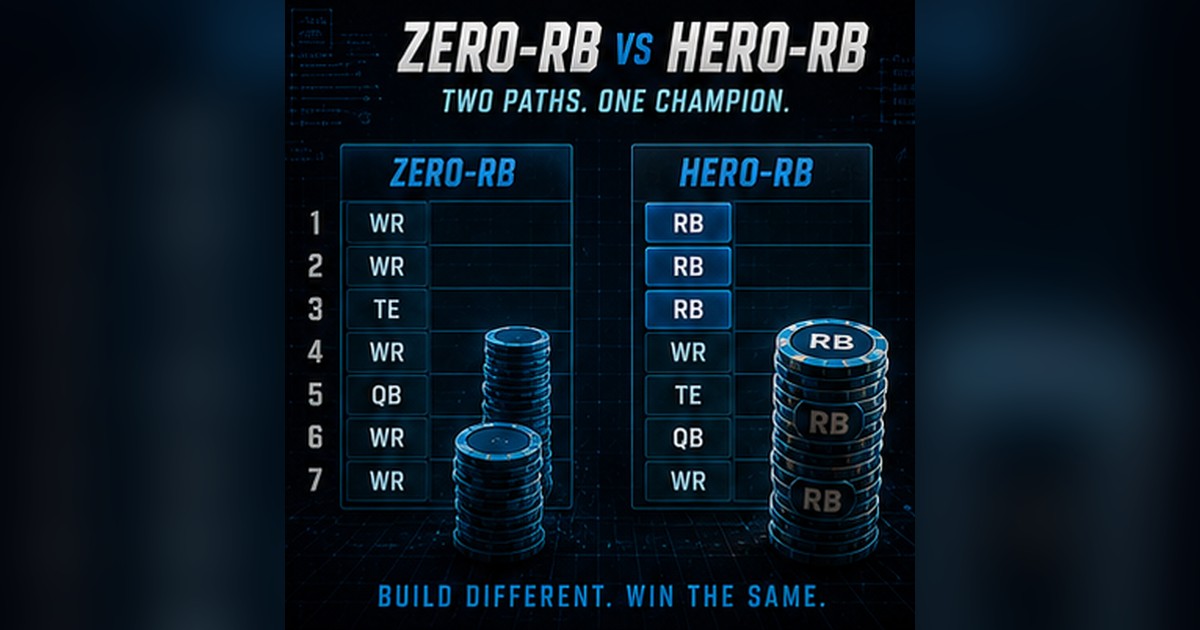
- Zero RB punts running back early, stacks elite pass catchers, and rebuilds the position from the middle rounds and waivers.
- Hero RB buys one workhorse early, then treats RB like Zero RB the rest of the way.
- League size and scoring decide it — full PPR and deep leagues favor Zero RB; smaller leagues and standard scoring favor Hero RB.
- Neither works without a plan for weeks 1-4 — you need bodies with real touches while the lottery tickets develop.
Every August, somebody in your league drafts three running backs in the first three rounds, posts a screenshot, and declares the title race over. And every October, half those backs are hurt, benched, or splitting work with a rookie. Running back is the most fragile position in fantasy — which is exactly why the two most popular draft strategies of the last decade are both built around not trusting it.
Here's how Zero RB and Hero RB actually work, where each one wins, and how to decide which one belongs in your draft this year.
How Zero RB works
Zero RB is simple to describe and hard to execute: for roughly the first five rounds, you don't draft a running back. You leave every draft with a receiving corps that terrifies your league, usually an elite tight end or quarterback, and a pile of running backs chosen for upside, not floor — handcuffs one injury from a starting job, pass-catching backs in ambiguous committees, and rookies whose role is trending up.
The logic rests on two things. First, wide receivers get hurt less and bust less. Second, the running back position replenishes itself in-season like no other — every year, backs who went undrafted finish inside the top 24 at the position because a starter got hurt and volume landed in their lap.
Zero RB doesn't avoid running backs. It avoids paying retail for them.
How Hero RB works
Hero RB (you'll also hear Anchor RB) concedes one point to the RB truthers: a true three-down workhorse is the most valuable single asset in fantasy. So you buy exactly one — a first- or second-round back with a locked-in bell-cow role — and then you don't touch the position again for four or five rounds.
You get the stable RB1 production Zero RB teams spend September chasing, while still building the receiver depth that wins leagues in December.
Head to head: where each strategy wins
| Factor | Zero RB | Hero RB |
|---|---|---|
| Best scoring format | Full PPR | Half PPR / Standard |
| Best league size | 12+ teams | 8-10 teams |
| Early-season risk | High — RB room is thin in September | Moderate — one injury hurts |
| Late-season ceiling | Highest — if the lottery tickets hit | High and steadier |
| Waiver-wire dependence | Heavy | Moderate |
Which one should you run in 2026?
Run Zero RB if...
- Your league is full PPR and 12 teams or deeper.
- You pick late in round one, where the elite workhorses are gone anyway.
- You're an active waiver player. Zero RB is a season-long job, not a draft-day trick.
Run Hero RB if...
- You pick in the top half of round one and can land a genuine bell cow.
- Your league is 10 teams or fewer, where the waiver wire gets stripped bare.
- You want most of Zero RB's receiver edge without white-knuckling September.
The trap either way: drafting mediocre middle-round backs "just to be safe." That's the dead zone — backs priced like starters who produce like backups. Both strategies exist specifically to skip that tier. Commit.
The pick'em angle
The same logic that powers Zero RB — running back production is fragile and matchup-driven — is why September point spreads move so much on backfield news. When a workhorse sits, books adjust but the public overreacts. In your pick'em pools, that's the week to fade the noise: offenses with elite passing games absorb an RB injury far better than casual pickers assume.
The bottom line
Zero RB and Hero RB are the same worldview at different prices: running backs are volatile, so pay for certainty exactly once or not at all. Pick the version that fits your league's size and scoring, commit to it, and spend the season working the wire like it's a part-time job.
And if you like backing your reads with something on the line every Sunday — that's literally the game.