Key takeaways
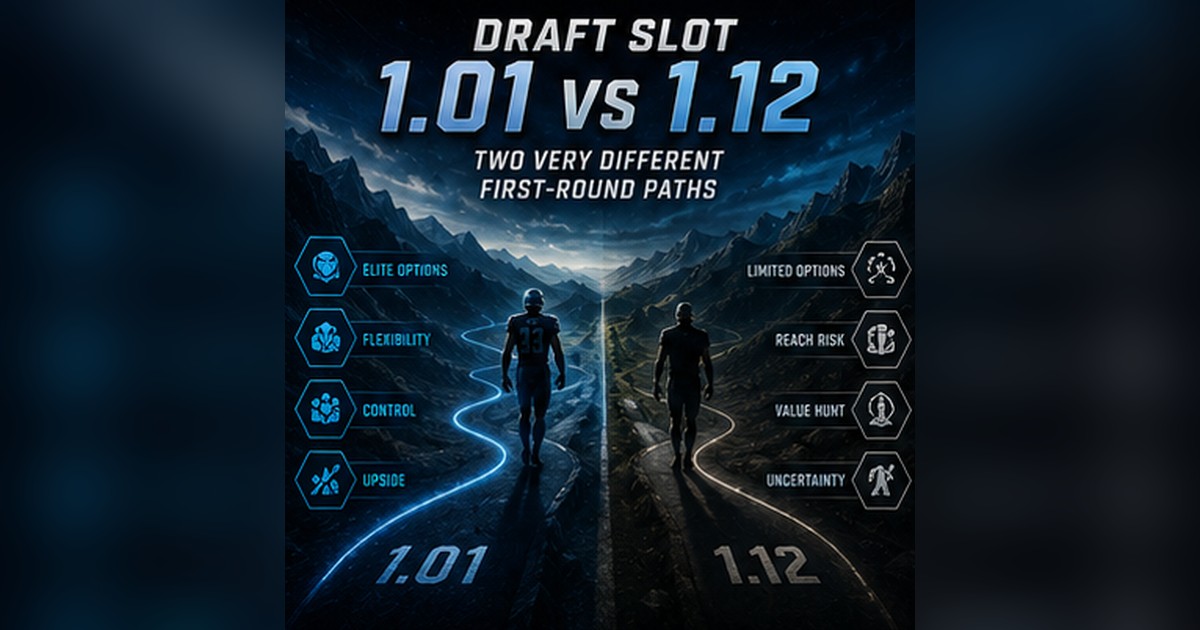
- Your draft slot is a strategy, not a nuisance. Picks 1-3, picks 4-8, and picks 9-12 are three completely different drafts. Stop using the same cheat sheet.
- Top three: Take the elite RB (Bijan or Gibbs), then anchor around him. You have positional certainty everyone else in the room is chasing.
- Middle (4-8): This is where the smart WRs get paid. Chase, Jefferson, whoever's available — the RB tier drops off a cliff at 5 or 6 anyway.
- The turn (9-12): You get paired picks. Plan them as pairs, not two isolated selections. This is where zero-RB or hero-RB actually gets executed.
- The pick'em angle: the same "slot" thinking applies to survivor pool weeks.
Here's the thing nobody wants to admit about fantasy draft prep: 80% of the strategy content online treats every pick like it's the same pick. Rankings, tiers, ADP charts, cheat sheets — almost none of it changes based on where you're actually sitting. That is a spectacular waste of prep time.
Because the pick you drew changes everything. The player you can realistically get, the runs that will happen around you, the pockets of value that survive to your next selection — all of it is a function of slot. And every year, the leagues where I finish top-two have one thing in common: I built the plan around the slot before I built it around the players.
Picks 1-3: The anchor draft
Congrats, you got the top of the board. Now stop overthinking it. This is the year of Bijan Robinson at 1.01 or Jahmyr Gibbs at 1.02, with Ja'Marr Chase in the mix for teams that punt on the elite RB tier. The correct pick is whichever of those three fits your positional philosophy; the wrong pick is trying to be clever with a QB reach or a rookie flyer.
What matters more than the pick itself is the plan that comes after. You're picking again at the 22-24 range. That's a full round after every top-eight RB comes off. That's why sitting at the top of the board and taking Bijan is powerful — you've locked one positional certainty in a year where positional certainty is scarce, and you get to spend your second and third picks hunting WR ceilings while everyone in the middle is scrambling for the RBs you already have.
Do: If you're at 1.01, decide before draft night whether you're Bijan-into-Chase-if-he-falls, or Bijan-into-back-of-first-WR. Have a rank of five WRs you'd be happy taking at the turn, and don't chase the tier when it breaks.
Picks 4-8: The best-available seat
This is arguably the best draft slot in the room and nobody talks about it. You are almost certainly getting an elite receiver — probably Chase or Justin Jefferson depending on order — and your next pick lands right in the middle of the second-tier RB pocket. That's not compromise; that's Chase and a top-eight-ceiling running back.
The trap at 4-8 is the QB reach. Some poor soul in every draft in this range takes a top QB in the second and immediately hamstrings their build. Don't be that person. QB value in 2026 lives in Round 8+, and there are five QBs I'd take at their current ADP over any top-three QB at his. This is a battleground I've written up in detail in the zero-RB versus hero-RB post if you want the framework — the short version is you should almost never spend a Round-3 pick on a QB when you can spend a Round-3 pick on a WR2 nobody else in your league has.
Picks 9-12: The turn
The turn is the most misplayed draft slot in fantasy. You do not get two picks; you get one paired pick. Whatever you take at 9-12, you have to think about what you can pair it with at 13-16 in the same breath. If you can't confidently name that second player, don't take the first.
The correct approach at the turn in 2026: WR-WR. The middle-round RB pocket is thinner than most people admit, and the top-heavy WR class means that if you can walk out of Round 2 with two receivers you like, you've done something the middle of the board cannot.
The other viable turn move is hero-RB — take one of the RB1s slipping to you with your first pick, then hammer WR/TE for the next four rounds. Zero-RB from the turn is a valid but harder path; you're forcing the strategy from a slot that doesn't offer natural RB1s, which is a real cost.
Trap: RB-RB at the turn. The math almost never works. You'll spend the middle of the draft chasing WRs that other teams have anchored, and by Round 6 you'll be trying to find a WR2 in a room that has none. The pain compounds for eight more rounds.
Middle rounds: where drafts are actually won
Whatever your slot, Rounds 5-9 are where you make or lose your season. Every draft slot converges here to the same problem: you need a second RB you believe in, a third WR you believe in, and probably a tight end. The pool is narrow and everyone is picking from it at once.
This is where the late-round sleeper board pays off, but the middle rounds are their own thing. Target players with clear paths to touches: injury-vacated backfields, WR2s in improved offenses, tight ends whose situation just got upgraded. Fade names that require both a role change and a talent leap — those hit at maybe a 15% clip and you're paying full price for the ticket.
The tight-end and QB question
Both positions are late-round targets in 2026 regardless of slot. TE value lives in the 8-14 range where guys like Pat Freiermuth, Cade Otton, and Juwan Johnson are being priced closer to backups than starters. Freiermuth in particular has emerged as a breakout candidate in Pittsburgh's new offense — that's a Round 11 pick returning Round 5 production if the range of outcomes lands anywhere near the median.
QB value lives even deeper. Aaron Rodgers is going in Round 12+ and should start every game, which is a genuinely absurd ADP for a starter of any kind. The exception to late-round QB is if you legitimately love a top-three QB and can get him in Round 4 at a slot where the RB tier has already turned. That's a defensible reach. It's not a default; know why you're doing it.
Put it all together
The draft plan for your slot should exist on paper before you sit down at the draft. Not the specific players — the shape. What positions in what rounds, which pockets you're targeting, which players you're willing to reach a round for, which ones you'd rather trade back and hunt. If you build the shape first and let the specific names slot into it as the board falls, you'll draft calmly while everyone around you panic-picks.
| Slot | Round 1 lane | Round 2 lane | The trap |
|---|---|---|---|
| 1-3 | Elite RB anchor | Top WR at the turn | Getting cute with a QB |
| 4-8 | Elite WR | Second-tier RB | Reaching for a QB |
| 9-12 | RB1 or top WR | Paired WR/TE | Doubling up on RB |
You don't build a draft around a player. You build it around the pick.
The pick'em angle
The slot logic applies to pick'em pools too. If you're in a survivor pool with a big field, the "top pick" for Week 1 is whichever heavy favorite has the widest audience — and that's exactly the team you want to fade if you need differentiation. Same idea as draft slot: your seat in the pool dictates the strategy, not just the odds. Small pool, take chalk. Big pool, get contrarian earlier than feels comfortable. Our full framework lives in the survivor pool guide, and it maps 1:1 to how you should be thinking about your draft slot.
Draft night is about executing a plan you built for the slot you drew. Get the plan right, and you'll have a top-two roster before you've even opened your kicker debate. If you'd rather skip the drafting and just call games right, that's the other thing we do — and upsets are literally the point.