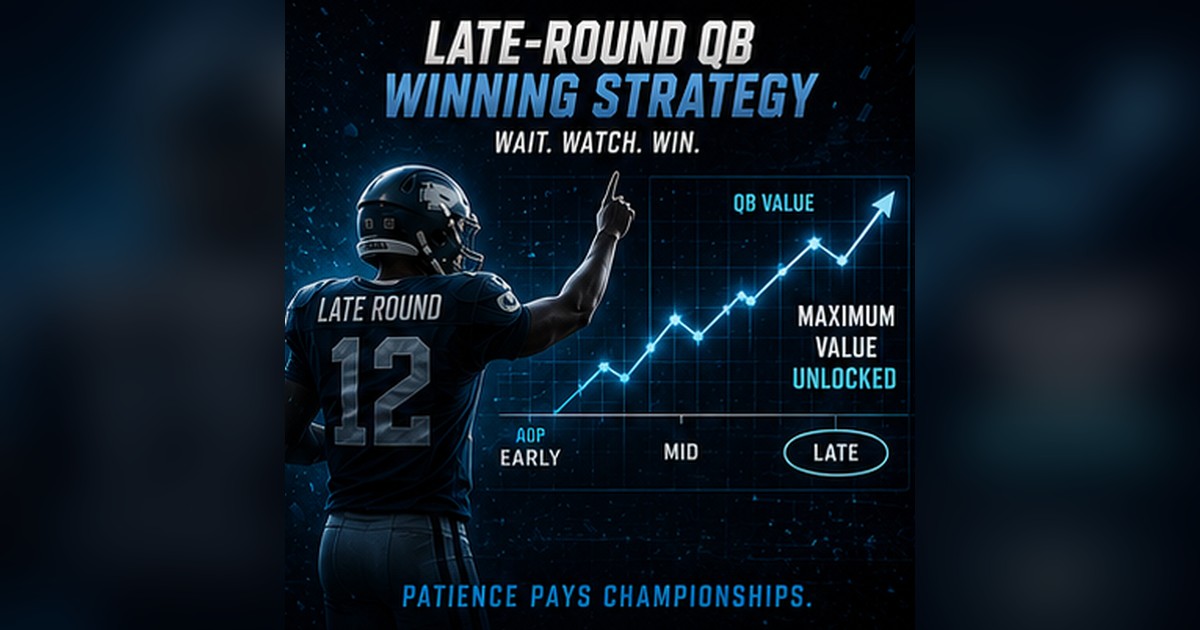
Key takeaways
- Late-round QB strategy is an argument about gaps, not about talent. The distance between the quarterback you take in Round 3 and the one you take in Round 12 is real, but it is smaller than the distance between the running back you take in Round 3 and the one you settle for once the room has picked the position clean.
- Quarterback is the deepest starting spot in the sport. Thirty-two teams start one, most lineups require one, and the waiver wire restocks it every single September.
- The 2025 offseason mostly moved defenses and coordinators. Micah Parsons landing in Green Bay and three new head coaches with actual offensive identities will reshape matchups you're picking against all fall.
- The new rules quietly matter. Hawk-Eye measurements and a permanent dynamic kickoff change tempo and field position; the tush push surviving its ban vote keeps a specific goal-line touchdown parked in the quarterback column.
- Pick'em and survivor pools invert the logic entirely. In redraft you are buying points. In a pool you are buying certainty, and certainty is the one thing an expensive quarterback cannot sell you.
Every August somebody in your league stands up in the group chat and declares that the position has changed, that quarterbacks score too many points to punt now, and that a late-round QB strategy is a relic from the era when your starter ran a naked bootleg twice a game and called it mobility. Then they take a quarterback in the third round, and by Week 6 they are starting a league-winning quarterback next to a running back room held together with tape.
Here's the thing. That person is not wrong about the raw scoring. They are wrong about what the scoring is worth. Fantasy football has never paid you for points; it pays you for points above what your opponent gets at the same roster slot. Those are different games, and only one of them is on your scoreboard.
So before you set your draft board for 2025, let's do the boring, unglamorous work of asking what the position actually costs you, what the offseason changed, and how all of it plays differently in a pick'em or survivor pool than it does in redraft.
Why late-round QB strategy still wins in 2025
The case is not that elite quarterbacks are bad. Obviously they aren't. The case is that the position replaces itself better than any other, and replacement is the only currency that matters in a snake draft.
Think about what happens when your Round 3 quarterback misses two weeks. You go to the wire and you find a starting NFL quarterback, because there are always a few sitting there — a new starter, a guy whose team just fired its offensive plan, a veteran on a team that's suddenly throwing forty times because it's losing every week. Now think about what happens when your Round 3 running back misses two weeks. You find a committee back on a bad offense, and you hope.
That asymmetry is the whole strategy. Positional scarcity is not about how many points a position scores. It's about how badly you're punished for being wrong.
You do not draft a quarterback. You draft the difference between your quarterback and the quarterback the guy who waited will be starting in Week 8. Historically, that difference has been smaller than anyone is comfortable admitting — and it costs three rounds of running back and receiver to buy it.
The replacement-level problem nobody drafts around
There's a second, sneakier reason waiting works: quarterback production is unusually schedule-dependent and game-script-dependent. Passing volume spikes when teams trail. Rushing production from quarterbacks spikes near the goal line and in bad weather. Neither of those is something you can reliably buy in the third round — they're circumstances, and circumstances rotate.
Which means the correct way to run a late-round QB strategy is not "take one quarterback late and pray." It's this:
- Take two quarterbacks late, in different tiers of risk. One with a stable job on a competent offense, one with rushing upside or a bad defense behind him.
- Play the matchup weekly. If you refuse to stream, you have converted a flexible asset back into a fixed one and given away the advantage you drafted for.
- Stay ruthless in September. The most valuable waiver quarterbacks of any season are almost never on rosters in Week 1. Somebody wins a job, somebody gets benched, somebody's team starts losing by two scores every Sunday.
A useful gut check on draft day: if you took the quarterback and you now feel relieved, you probably paid market price. If you took the quarterback and immediately felt slightly nauseous about your running backs, you definitely overpaid.
What the 2025 offseason actually changed
The headline move of the summer was not a quarterback at all. On August 28, the Cowboys traded Micah Parsons to the Packers for Kenny Clark and first-round picks in 2026 and 2027, and Parsons signed a four-year, $188 million deal with $120 million guaranteed — the largest contract ever given to a non-quarterback. Green Bay just bought a pass rush that changes how you should feel about every NFC North passing matchup, and Dallas just sold one.
The coaching carousel pointed the same direction: at scheme, not at star power. Mike Vrabel is running New England. Ben Johnson took over in Chicago. Liam Coen is in Jacksonville. Three teams with genuinely new identities, three sets of offensive tendencies nobody has current tape on, and three sources of the kind of early-season mispricing that quietly decides pools.
None of that argues for spending draft capital at quarterback. All of it argues for flexibility. When a third of the league is running a scheme it did not run last December, the guy who can pivot week to week beats the guy who locked in a projection in August.
The rule changes that quietly matter
The 2025 rulebook has three items worth a fantasy manager's attention, and one of them is directly a quarterback issue.
- Hawk-Eye virtual measurement replaced the chain crew as the primary way first downs get measured, with six 8K cameras cutting a roughly 70-second ritual to around 30 seconds. The chains are still there as a backup. Fewer stoppages generally means a slightly faster game, and faster games mean more snaps to go around.
- The dynamic kickoff is permanent. Starting field position is a real input into scoring environments, and it is now a stable input instead of an experiment.
- The tush push survived. The proposed ban failed 22-10, two votes short of the 24 it needed. That is not a footnote for anyone evaluating quarterbacks, because it preserves a play that funnels short touchdowns to the quarterback instead of to a running back.
Notice that the tush push vote is the one rule change that pushes toward quarterback scoring — and it applies to a handful of teams that actually run it well, not to the position broadly. That is exactly the kind of narrow, team-specific edge you should be buying in Round 12, not Round 3.
The pick'em and survivor angle: draft capital doesn't score points
Here is where a lot of fantasy-brained advice falls apart, because pools are a different game with a different failure mode.
In redraft, your enemy is variance around a season-long total. In a pick'em pool, your enemy is a single wrong box on a single Sunday, and in survivor it's one wrong box, ever. Those failure modes reward opposite instincts. Redraft rewards upside. Survivor rewards boredom.
Three ways the late-round QB mindset translates to the pool side of the site:
- Don't pay for name recognition in a survivor pick either. The most-picked team every week is usually the team with the most famous quarterback, not the team with the largest edge. Those are not the same list, and the difference between them is where pools get won.
- Volatility is a feature in redraft and a bug in survivor. A running quarterback who might hang thirty on you is a great Round 12 dart. A running quarterback whose team lives and dies on his legs is a terrible thing to stake your entire season on in Week 3.
- Early-season uncertainty is an opportunity, not a hazard. New coaches in New England, Chicago and Jacksonville mean the market is guessing right along with you in September. That's the window to be contrarian — before three weeks of results calcify everyone's opinion.
If you're running both a fantasy league and a pool this year, keep those two brains separate. Set your lineup for points and set your weekly picks for certainty. The manager who confuses the two ends up starting his favorite quarterback's team on a road spot he'd never otherwise touch.
How to execute it on draft day
Concretely, without pretending anybody knows what Week 9 looks like yet:
- Build the first five or six rounds entirely from running backs and receivers. If a quarterback falls far enough that he's genuinely the best player available by a distance, take him — the strategy is a default, not a religion.
- Target two quarterbacks in the back half. Different bye weeks. Different risk profiles.
- Draft the backup you'd actually start, not the handcuff nobody else wants.
- Have a wire plan for Weeks 1-3, because September churn at quarterback is the most predictable thing in the sport even when the specific names are not.
- Check what your scoring settings do to rushing quarterbacks before you decide any of this. Six-point passing touchdowns and generous rushing yardage change the shape of the argument, and a league that has drifted toward superflex changes it completely.
The season starts this week and nobody knows anything yet, which is the honest and slightly thrilling part. Three new head coaches, a rebuilt Green Bay front, a measurement system that has never been used in a regular-season game, and a kickoff rule that is now permanent instead of provisional. Some of that will matter enormously by Halloween and some of it will be a trivia answer. Wait on quarterback, keep your roster flexible, and let the first month tell you which is which. We'll be tracking the fallout weekly, and you can watch how it shakes out on the season stats page as the results come in.