Key takeaways
- There's no required TE slot in this league. A tight end fills a REC_FLEX spot and has to out-produce a wide receiver to earn it — and six years of this league's own draft data show tight end has never been a position that runs here anyway.
- The TE cliff is brutal and sits right after pick 21. Trey McBride and Brock Bowers go off the board in the second round; the next tight end doesn't come off until pick 38, and there's no tier in between at all.
- Full PPR narrows the receiving gap between tight ends and receivers, which is exactly why a mediocre TE1 is a worse REC_FLEX play than a good WR3.
- A deep pool of streaming options exists if you skip the position early. Brenton Strange, Hunter Henry, T.J. Hockenson, Juwan Johnson, Chig Okonkwo, Cade Otton, and Gunnar Helm are all available well after the cliff.
- PPR gives real receiving tight ends a scoring bump worth planning around — Jake Ferguson, Kyle Pitts, and Travis Kelce all pick up more than 25 points of extra full-season value over standard scoring.
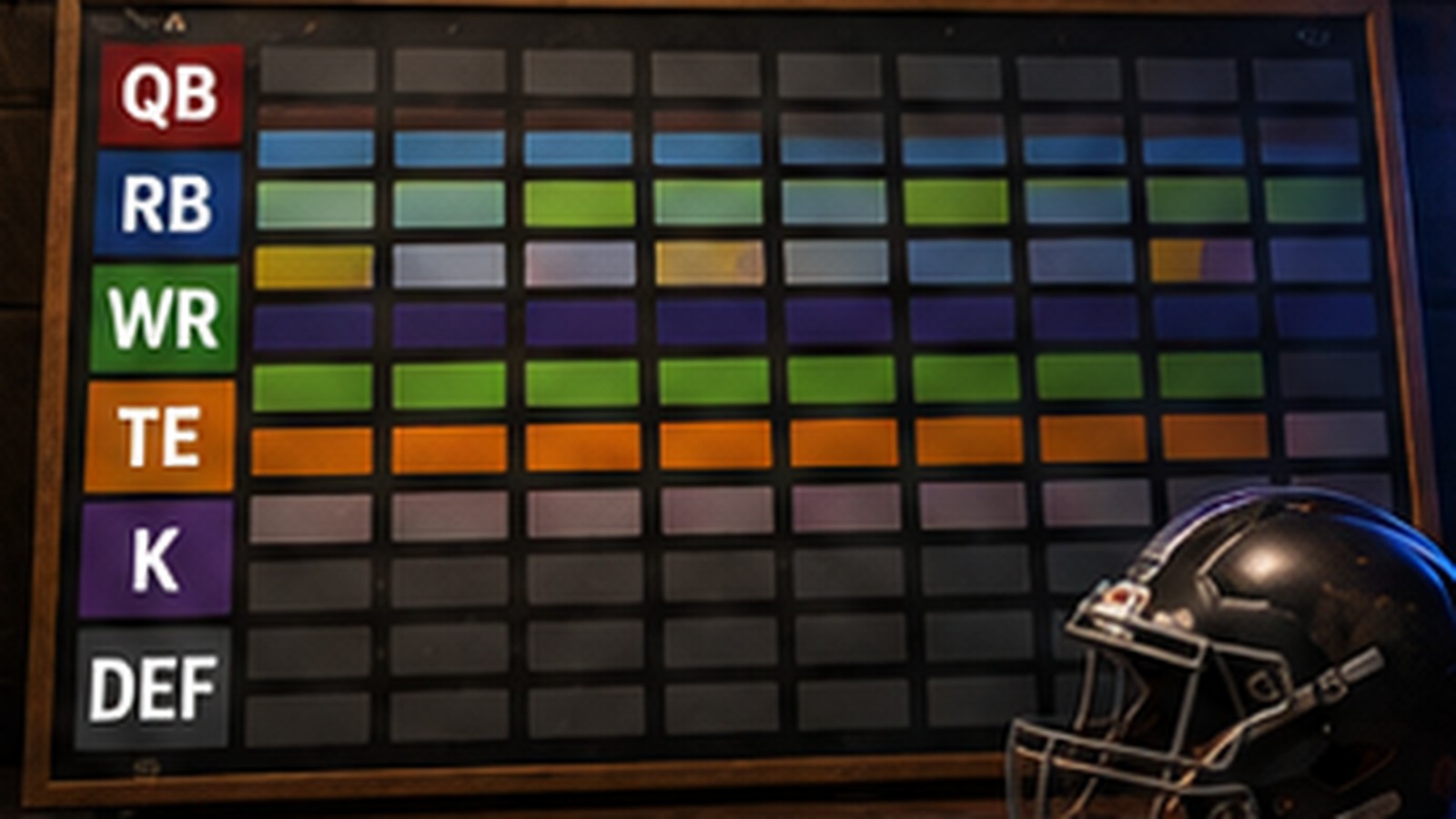
Every fantasy draft guide tells you tight end is a "get one of the top two or punt" position, and every fantasy draft guide is written for a league that requires a TE. This league doesn't. There's no dedicated tight end slot on this roster — just QB, two RBs, three REC_FLEX spots, a kicker, and a defense. A tight end you draft is fighting a wide receiver for one of those three flex spots, full stop, which means the entire "do I need a TE" conversation collapses into one simpler question: is this specific tight end better than the receiver you'd otherwise start there?
That reframes the TE cliff from a scarcity problem into a value problem. You're not comparing tight ends to other tight ends. You're comparing them to the back half of your WR board, and most years that comparison isn't close.
Why the TE cliff hits differently with no required TE slot
In a standard 1-TE-required league, even a mediocre tight end has a floor: he starts, because something has to occupy that slot. Take the mandatory slot away and that floor disappears. Now a tight end has to clear the bar set by whichever receiver is sitting fourteenth, eighteenth, or twenty-second on your board, because that's the player he's actually replacing in your lineup.
That's a much higher bar than "starting tight end" implies. It's also why the position splits so cleanly into two groups this year: a small handful of tight ends good enough to start over a real receiver, and everyone else, who you should be drafting as a bench dart, not a starter-in-waiting.
It also changes how you should think about roster construction over the full fourteen rounds. In a league that requires a tight end, you're forced to fill that slot no matter how the board falls, which means you sometimes reach. In this league, you're never forced to reach — you can carry zero rostered tight ends into September and simply start your best three receivers every week, and nothing about your lineup is illegal or even unusual. That freedom is exactly what makes the position worth thinking about differently than every generic draft guide you'll read this month.
The tier data: a cliff, then nothing, then a cliff again
Here's the board by expert consensus overall rank, and the gap in the middle is not a typo:
- TE1 Trey McBride (ARI) — ranked 15th overall. A true weekly starter over almost any receiver you'd otherwise flex.
- TE2 Brock Bowers (LV) — ranked 21st overall. The last tight end worth reaching for.
- The cliff. Nothing. No tier-3 grouping exists between picks 21 and 38 at the position — it's the widest gap on the entire draft board.
- TE3 Colston Loveland (CHI) — ranked 38th overall.
- TE4 Tyler Warren (IND) — 53rd.
- TE5 Tucker Kraft (GB) — 69th. Coming back from an ACL tear and likely opens the year on PUP, so treat the ADP as a discount with an attached wait.
- TE6 Fannin (CLE) — 71st.
- TE7 Kyle Pitts (ATL) — 79th.
- TE8 Sam LaPorta (DET) — 86th, and worth monitoring for a back issue heading into camp.
- TE9 Travis Kelce (KC) — 98th.
- TE10 Jake Ferguson (DAL) — 106th.
So the real decision tree is short. If McBride or Bowers falls to you at a point where you're comfortable starting a tight end over your next-best receiver, take him — he's a legitimate REC_FLEX starter, not a TE-only value. If you miss both, the math says wait, because TE3 through TE10 are competing with each other for streaming duty, not with McBride and Bowers for a top-two label.
The tight ends worth drafting early aren't "TE1" and "TE2" so much as they're wide receivers who happen to line up in a three-point stance sometimes. Everyone after them is a bench piece wearing a starter's price tag if you draft them too soon.
The league doesn't run on tight ends — the numbers prove it
None of this is theoretical for this specific league, either. Across six seasons and 1,080 career picks, tight end sits next to the bottom of the position chart — just 70 picks total, barely ahead of kicker's 69 and dwarfed by 408 receivers and 338 running backs. Tight end has never been the position this league runs on, and the draft-order data backs that up in a way that makes the punt strategy an easy call: the most tight ends ever taken in a single round, across six years, is eight. Most rounds see two to five. There has never been a stampede at the position, and there's no reason to expect 2026 is the year that changes.
The first tight end off the board is also wildly inconsistent from year to year — pick 7 in one season, pick 30 in another, with the other four seasons landing somewhere in between. That's not a market with a settled opinion on when McBride- or Bowers-caliber talent needs to be drafted. It's a market that reaches early some years and waits other years, which is exactly the kind of inconsistency a punt strategy is built to exploit — you're not fighting a consensus, because there isn't one.
Manager behavior tells the same story. Across six seasons no manager has made tight end a repeatable part of their early-round plan; the highest single-season share of first-five-round picks spent on the position is an outlier from one five-pick sample, not a strategy anyone has run twice.
The case for punting the position entirely
Full PPR is exactly the scoring system that makes this punt viable, because it rewards the receiving tight ends who separate from the pack most in exactly the format you're playing. The gainers list — points added by switching from standard to full PPR — tells the story:
- Jake Ferguson +31.9
- Kyle Pitts +30.6
- Travis Kelce +25.5
- Fannin +18.3
- Tyler Warren +18.3
Every one of those names shows up outside the cliff, well into TE4-and-later range. That's not a coincidence — it means the tight ends who benefit most from your league's scoring format are also the ones available cheapest, which is about as clean an inefficiency as fantasy football offers.
And if none of those names are on the board when you're ready to fill the position, the waiver-wire-adjacent tier is deep this year: Brenton Strange, Hunter Henry, T.J. Hockenson, Juwan Johnson, Chig Okonkwo, Cade Otton, and Gunnar Helm are all available well outside the top ten at the position, and any one of them is a perfectly reasonable streaming option in a given week. In a league with three flex spots and no TE requirement, you don't need a great tight end. You need a good enough one on the weeks a receiver bye or matchup makes it the smarter start.
The punt strategy here isn't "ignore tight end." It's "don't pay a premium for the middle of the position." Rounds three through seven should go to receivers and running backs almost every time; rounds eight through eleven are where a Fannin, a Pitts, or a Warren becomes a rational, low-cost bet that this specific format rewards more than most.
The pick'em angle: know when a position is overrated
The skill that lets you correctly punt tight end in your draft is the same skill that wins you weekly picks: recognizing when the field is overpaying for a name instead of a role. Public bettors and public drafters both gravitate toward star power at positions where it doesn't necessarily translate into an edge — a famous tight end feels safe to draft the same way a famous quarterback feels safe to pick against the spread, even when the numbers say otherwise. When you're setting your league standings and sizing up who's actually building a roster with structural advantages versus who's just drafting name recognition, the tight end cliff is a good early tell. The managers who reach for TE5 through TE10 in rounds four and five are often the same ones who'll chalk favorites out of habit come Sunday.
Same discipline, different board: find the spot where the field is paying for reputation, and go the other direction — the same logic that fills out our late-round value targets guide.
How to plan your draft around it
Set a hard rule before you sit down: McBride or Bowers only if the value is real, nothing at the position between picks 22 and 37, and a streaming target from the Fannin/Pitts/Warren tier once you've built out your receiver corps. Keep the deep names — Strange, Henry, Hockenson, Johnson, Okonkwo, Otton, Helm — on a separate short list for waivers, because at least one of them will be a matchup-proof streamer by October regardless of where the position shakes out on paper. The WR tiers for this format are where your flex spots actually get won — treat tight end as the position you solve last, not first, and you'll walk away from the draft with three flex starters instead of two and a hope.