Key takeaways
- Three REC_FLEX spots turn this into a receiver league. Only two RB slots are mandatory, there's no required TE, and you're filling three flex spots almost entirely with wide receivers in full PPR — and six years of this league's own draft history (408 WR picks to 338 RB) already leans that way.
- The WR tiers run six deep at the top, then get murky fast. Ja'Marr Chase, Puka Nacua, Jaxon Smith-Njigba, Amon-Ra St. Brown, CeeDee Lamb, and Justin Jefferson are off the board before anyone blinks.
- ESPN drafters are handing away free value. They take WRs 10 to 25 picks later than mock drafters do — A.J. Brown falls from pick 13.5 to pick 27.1, Tee Higgins from 27.1 to 52.1.
- The 2026 receiver map got shuffled. A.J. Brown, Jaylen Waddle, DJ Moore, Mike Evans, and Davante Adams all changed teams this offseason.
- If your league drafts on ESPN, exploit it on purpose. Let the room reach for a third running back while you bank WR2 talent at WR3 prices.
Here's the question worth asking before you set a single WR tier on your board: in a league with QB, two RBs, three REC_FLEX spots, a kicker, and a defense, how many of your fourteen rounds should actually go to wide receivers? The honest answer is more than you're used to. Standard-format rankings assume two mandatory receiver slots and a mandatory tight end soaking up targets elsewhere. This league has neither. It has two RB slots and three flex spots that will overwhelmingly get filled by pass-catchers, which makes WR tiers the single most important board you'll build all August.
The math isn't subtle. A typical 12-team roster here starts one QB, two RBs, three REC_FLEX (receiver or TE), a kicker, and a defense — nine skill-adjacent, non-QB, non-kicker starting spots, and only two of them are locked to running backs. Everything else in the flex is a bidding war between receivers and the handful of tight ends worth rostering. That bidding war is what this post is about.
Why WR tiers matter more here than in your other leagues
In a standard 2RB/2WR/1TE format, running backs get scarce fast because so few backs see full workloads, and the position has a hard floor of two mandatory starters plus flex competition. Take that same running back scarcity and put it in a league that only requires two RBs, and the scarcity stops mattering as much — you can leave a shaky RB3 or RB4 on your bench and simply start three receivers instead. The league is telling you, structurally, that receivers are the position you can't punt.
That doesn't mean ignore running backs in the first two rounds — Bijan Robinson, Jahmyr Gibbs, and Christian McCaffrey are still elite regardless of format. It means your WR tiers should drive rounds three through nine far more than they would in a standard league, because that's where you're filling three flex spots a standard-league drafter only fills one and a half of.
What six seasons of ITFFL drafts confirm
This isn't a hypothetical shift, either. Six seasons of this league's own draft history back it up. Across 1,080 career picks, wide receiver is the single most-drafted position in ITFFL — 408 picks, well ahead of running back's 338, and nowhere close for tight end (70), defense (76), kicker (69), or quarterback (119). This league already runs on receivers. The new lineup rules just made it official.
Round-by-round is where the pattern gets specific and useful. Rounds 1 and 2 still skew running back across the league's history — 74 RB picks to 57 WR — so early workhorse backs get scooped fast, and that instinct isn't wrong for the truly elite ones regardless of format. But round 3 flips hard: 38 wide receivers get taken against just 19 running backs, and receivers stay the plurality pick across most of the rounds that follow. If your draft room runs true to form, expect the run on receivers to kick off right around where Tier 2 of this board ends.
Individual approaches vary, and both have worked. ITFFLGOAT and aal3 have each built more than half of their first five rounds around receivers (52% apiece) across their ITFFL histories, and aal3 has a championship to show for it. Any Given Sontag runs the opposite build — leaning running back early at 47% of first-five-round picks — and has two titles doing it. What the data doesn't support is splitting the difference and ignoring the round-3 pivot altogether; the managers who load up on running backs into rounds 4 and 5 are fighting the board, not reading it.
The 2026 WR tiers, top 24
Here's the board, grouped into tiers rather than a flat ranking, because the gaps between groups matter more than the order inside them.
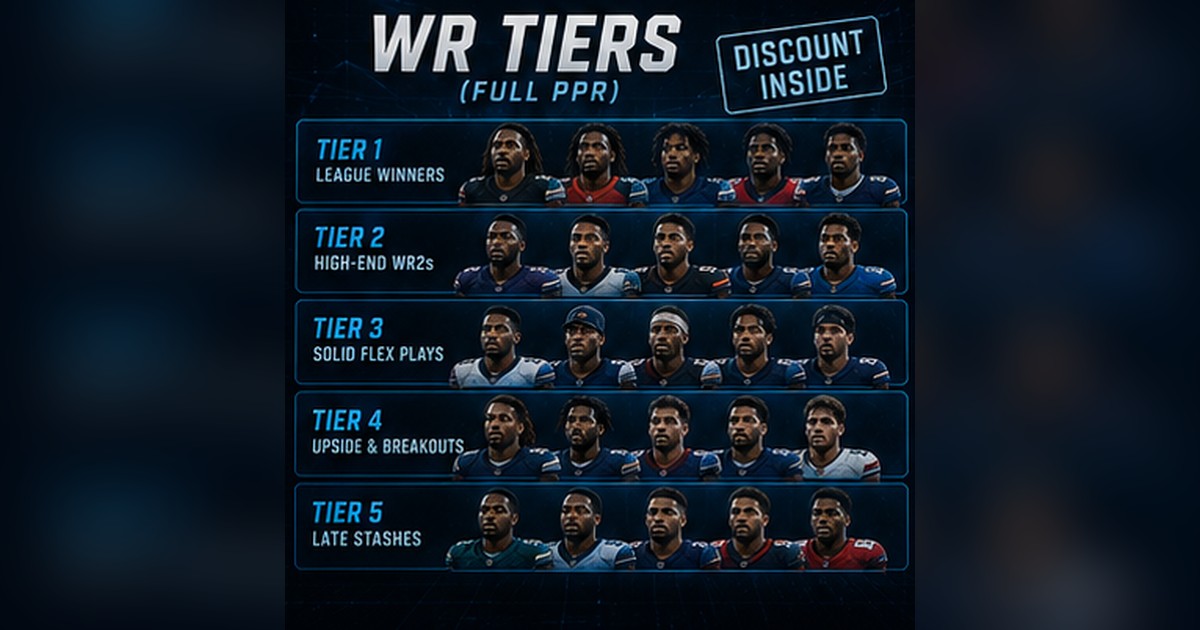
Tier 1 — take them whenever they fall, no debate: Ja'Marr Chase (CIN), Puka Nacua (LAR), Jaxon Smith-Njigba (SEA), Amon-Ra St. Brown (DET), CeeDee Lamb (DAL), Justin Jefferson (MIN). Six receivers, and every mock has them gone inside the first ten picks.
Tier 2 — the last true WR1s: Drake London (ATL), A.J. Brown (NE), Nico Collins (HOU), George Pickens (DAL). This is where the format edge starts to show up, because A.J. Brown is being drafted like a WR2 on ESPN boards specifically — more on that below.
Tier 3 — high-floor WR2s: Chris Olave (NO), Rashee Rice (KC), DeVonta Smith (PHI), Garrett Wilson (NYJ), Tetairoa McMillan (CAR).
Tier 4 — the discount tier: Zay Flowers (BAL), Tee Higgins (CIN), Ladd McConkey (LAC), Jaylen Waddle (DEN), Emeka Egbuka (TB), Malik Nabers (NYG). This is the deepest, most mispriced tier on the board, and it's where the ESPN gap does the most damage to anyone drafting against it. One flag here: Nabers is working back from a second surgical cleanup on his knee and is expected to miss the first month under the new PUP rule, eligible around Week 5. ESPN drafters, sitting at an ADP of 34.9, have not priced that in.
Tier 5 — flex luxury, take on value: Terry McLaurin (WAS), Luther Burden (CHI), Davante Adams (LAR).
The receivers in Tier 4 are not lottery tickets. They're proven, targeted players who happen to be sitting behind bigger names on ESPN's board for reasons that have nothing to do with talent. That's the entire opportunity in one sentence.
The real edge: ESPN drafters are giving away your receivers
This is the most useful thing in this entire draft guide, so don't skim it. Comparing live full-PPR mock ADP against ESPN's own live draft ADP shows a consistent, repeatable pattern: ESPN drafters take running backs earlier and wide receivers dramatically later than the broader mock-draft market does. The gap isn't a rounding error — it's ten to twenty-five picks on the receivers who matter most in a three-flex format.
Look at the size of it:
- Tee Higgins — pick 27.1 in mocks, pick 52.1 on ESPN. A two-round gift.
- Ladd McConkey — 36.5 vs. 57.6.
- Zay Flowers — 25.3 vs. 44.1.
- Luther Burden — 46.1 vs. 75.9.
- Jaylen Waddle — 41.1 vs. 60.4.
- A.J. Brown — 13.5 vs. 27.1. In mocks he's a back-of-first-round pick. On ESPN he's still there in the middle of round three.
If your leaguemates draft on ESPN's platform, that discount is sitting right there for you to take. The mechanism is simple: ESPN's default rankings and ADP have historically leaned RB-heavy, and drafters anchor to whatever the app puts in front of them. In a league that only starts two running backs, that instinct is actively working against them and actively working for you. Let the room bid running backs up to mock-draft-plus prices in rounds two and three, and use the picks you save to land Tier 2 and Tier 4 receivers a full round or two later than you'd need to elsewhere.
The inverse trade exists too — Malik Nabers and rookie Jeremiyah Love both get drafted earlier on ESPN than in mocks, which tells you where not to expect a discount. But receivers are where the gap runs one direction, hard, and that's the actionable part.
The offseason moves that reshuffled the receiver board
Team context changed for several receivers who matter to your board, and stale team labels are everywhere in draft content right now — verify anyone you draft against the actual 2026 roster, not the jersey you remember from last fall.
- A.J. Brown left Philadelphia for New England. He's still going in the back half of round one in mocks and, per the discount above, dramatically later on ESPN.
- Jaylen Waddle left Miami for Denver. New offense, new quarterback situation, and a Tier 4 price tag that undersells his target volume.
- DJ Moore left Chicago for Buffalo. A change in QB situation worth weighing against his new target competition before you rank him inside the Tier 5 group.
- Mike Evans left Tampa Bay for San Francisco. A new offense entirely at a stage of his career where role clarity matters.
- Davante Adams is now with the Rams, not the team most preseason content still has him on. He's a Tier 5 flex piece there, not a WR1 anywhere.
None of these five needed a name change to matter — they needed a context change, and context is exactly what stale articles get wrong first.
The pick'em angle: volume over name value
The same discipline that wins you receivers on draft day should run underneath your weekly picks. A three-flex, full-PPR format rewards you for identifying which receivers are getting fed targets regardless of name recognition — the same skill that separates a sharp weekly pick from a public one. The public leans on name value in survivor and pick'em pools the same way ESPN drafters lean on running backs: it's the anchor everyone reaches for by default. When you're setting your weekly picks, ask the same question you asked at your draft table — who's getting the volume, not who's the most famous name attached to the offense. Receivers piling up targets in a new scheme (Brown in New England, Waddle in Denver, Evans in San Francisco) tend to signal which offenses are actually humming on a given Sunday.
It's the same underlying edge in two different formats: find where the market hasn't caught up to the target share yet, and get there first.
How to build your board around this
Don't force a run on receivers in rounds one and two just because this is a receiver-heavy league — Chase, Nacua, JSN, and the other Tier 1 names are correctly priced everywhere, format or not. The edge shows up in Tier 2 and gets loudest in Tier 4, exactly where your third flex spot gets filled. Sketch your WR tiers before you sit down, note which leaguemates draft from ESPN's app if you know their habits, and let a fringe RB3 sit on the board a round longer than you're used to. In this format, that's not a punt. That's the format working as designed.
Check out the RB tiers companion piece for the other half of your board, and see how the tight end math falls apart after pick 21 in this same three-flex structure — a league with no required TE slot changes that position's value more than almost anything else on the board.