Key takeaways
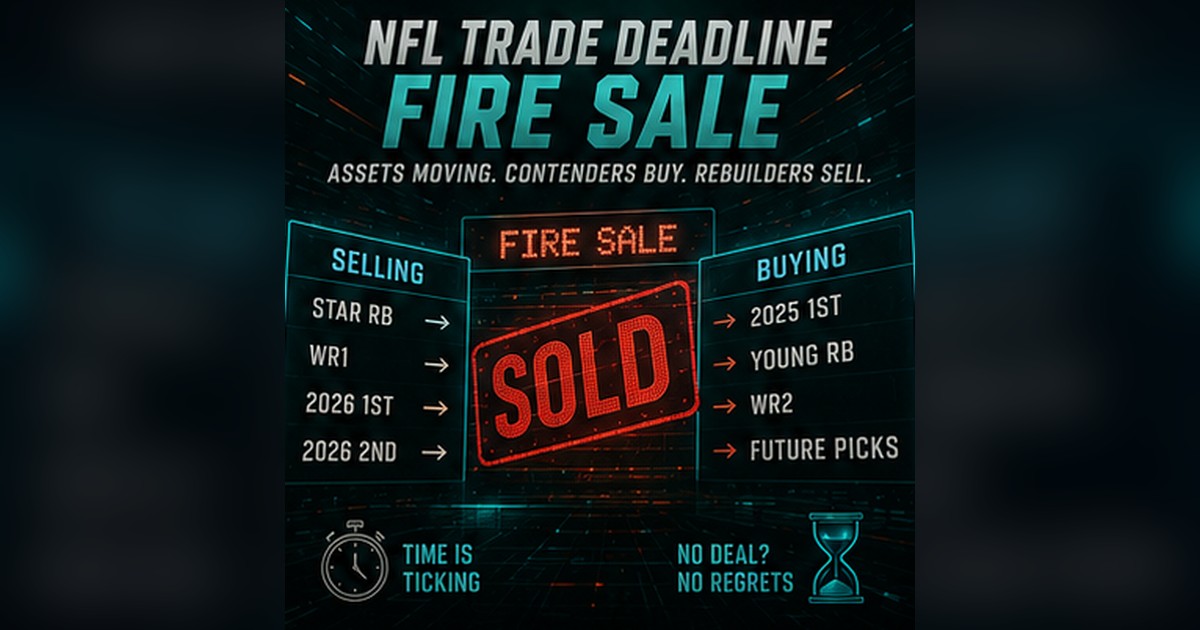
- The Jets ran an actual fire sale at the NFL trade deadline 2025. Sauce Gardner went to the Colts, and hours later Quinnen Williams went to the Cowboys with defensive tackle Mazi Smith coming back the other way.
- Dallas bought at both ends of the calendar. They added Williams and linebacker Logan Wilson from Cincinnati in November after sending two first-round picks and Kenny Clark to Green Bay for Micah Parsons back in August.
- A seller's players get cheaper and a seller's opponents get easier. Both facts move fantasy value, and only one of them moves it up.
- Pick'em angle: the spread adjusts to a gutted roster within a week. Your pool's consensus takes three. Live in that gap.
- Survivor angle: a punting team is not automatically a safe opponent. Week 8 just proved that in the most expensive way possible.
The NFL trade deadline 2025 came and went on November 4, and for most of the league it was the usual shrug: a fifth-round pick here, a backup guard there, three teams talking themselves into a rental. Then the Jets decided to hold a garage sale and put two of the best defensive players in football on the table.
Sauce Gardner to Indianapolis. Then, within hours, Quinnen Williams to Dallas, with Mazi Smith heading to New York as part of the return. That is not a retool. That is a team looking at its own schedule, doing the math, and deciding the math is unpleasant.
Whether you play fantasy, pick spreads, or run a survivor entry, a deadline like this changes what the back half of your season looks like. Here is what actually moved.
What the NFL trade deadline 2025 fire sale actually was
Teams sell veterans all the time. What made the Jets' deadline different is who and how fast. Gardner and Williams are not aging contributors on expiring deals being flipped for a lottery ticket. They are premium, in-their-prime defenders at the two positions that most reliably break an offense: outside corner and interior rush.
Moving one of them is a signal. Moving both on the same afternoon is a statement that the current season has been formally abandoned in favor of a future one.
A note on what I am not going to do here: I am not going to tell you the exact draft-pick packages. Those numbers were flying around all evening from several directions and I could not verify them to my own satisfaction, so you are getting the players and not the picks. If a pick package is the load-bearing part of your take, wait a day for the official league transaction wire.
A deadline seller never announces it in the box score. They announce it in the third quarter of a one-score road game in December, when the roster runs out of players who care and the coaching staff runs out of reasons.
Dallas bought, and it started in August
The Cowboys had the loudest deadline in the league, and it was really the second half of a plan that started before the season did.
On August 28, Dallas traded Micah Parsons to Green Bay for Kenny Clark plus first-round picks in 2026 and 2027. Parsons then signed a four-year, $188 million extension with $120 million guaranteed, making him the highest-paid non-quarterback in NFL history. That is a genuinely enormous transaction that most of the league is still digesting.
Then at the deadline they went and got Quinnen Williams from the Jets and linebacker Logan Wilson from Cincinnati. Add it up and Dallas has spent this calendar year completely rebuilding the middle of its defense out of other teams' All-Pros while converting an edge rusher into premium future capital.
You can argue about whether that is smart. You cannot argue that it is passive. For our purposes the relevant part is simpler: Dallas games should get harder to score in, and Green Bay games should get harder to throw in. Both of those change the totals long before they change anyone's power rankings.
What a seller does to your fantasy roster
The fantasy fallout from teams punting the season is less about the traded players and more about everyone standing near them.
- Skill players on a selling team lose game script, not talent. A worse defense means more trailing, which means more passing volume and fewer running back touches. Pass-catchers on bad teams are fine. Their running backs usually are not.
- Skill players facing a gutted defense gain a week. This is the most actionable thing on the list, and it is why you should be looking at the schedule of everyone who plays the Jets between now and Week 18 before your opponents do.
- Defenses and kickers on selling teams are droppable. Immediately, without ceremony.
- Rookies and backups on a punting roster become dynasty-relevant. A team that quit in November plays its young players in December. That is where next year's breakouts audition.
This is the same underlying idea as the argument I made about valuing a hot backfield in October: the environment around a player moves his production more than his own ability does, and the environment just changed for several teams at once.
The waiver move nobody makes: when a contender adds a defensive player, check whether that team's opposing pass-catchers were on your streaming shortlist for the next three weeks. Half the value of the deadline for fantasy is deleting names from a list, not adding them.
The pick'em angle: pricing a team that punted
Here is the part that pays.
Betting markets absorb a roster change in about seventy-two hours. A pool full of humans absorbs it in about three weeks, because humans update on vibes and the vibe of "that team has good players" lingers well past the point where the good players have physically left the building.
That lag runs in both directions and both directions are exploitable. Early on, the spread will overreact to a fire sale before the actual on-field effect shows up, because the market prices the narrative. Later, your pool will underreact, because your league-mates are still picking the logo they remember from September.
My rules for the rest of the season:
- Fade the first week of overreaction. A team does not get worse by two touchdowns because it lost two starters on a Tuesday. Take the points once.
- Then ride the decline. The real damage from selling shows up in weeks four through eight after the deadline, when depth gets exposed and the locker room stops pretending.
- Trust the buyer's defense more than the buyer's record. Defensive additions show up in totals and in second halves faster than they show up in wins.
If your pool tracks weekly percentages, this is the stretch of the season where a couple of contrarian calls can move you five spots. Worth checking where you actually stand on the leaderboard before you decide how much risk you can afford.
The survivor angle: punting is not the same as losing
Now the warning, and it is a fresh one.
The obvious survivor logic after a fire sale is to start hunting the seller. Circle every remaining Jets opponent, pencil them in, feel clever. Do not do that on autopilot, because Week 8 already punished exactly that instinct — the Dolphins and the Jets both won outright, two of the three most-selected teams in the pool went down, and 51 percent of the remaining field was eliminated in a single Sunday.
Read that again. Half the survivors in one of the largest pools in the country were killed by teams everybody had already written off. A roster that has given up on the season still employs professional football players who very much have not given up on their next contract.
The lesson is the one the Week 5 massacre hammered home in a different key: your survivor risk is not the team you pick, it is how many other people picked it. A heavily backed favorite over a fire-sale opponent is the most crowded trade in the pool, and crowded trades in survivor are how fields get cut in half.
What to watch in the second half
Two things over the next month. First, whether Indianapolis and Dallas actually look different with their new defenders, or whether we all just watched a very expensive lateral move. Second, whether the Jets' remaining schedule turns into the free square everyone expects or another trap that quietly ends survivor entries.
There is also a coaching-carnage subplot building. Tennessee already fired Brian Callahan back on October 13, the first in-season change of the year, and a deadline where multiple teams openly sold is usually the leading indicator for more. Front offices that trade away All-Pros in November are rarely thrilled with the head coach in December.
We will have a much better read after Week 12. For now: adjust your streamers, take the points on the first overreaction, and do not let a fire sale talk you into a survivor pick you would not otherwise make.