Key takeaways
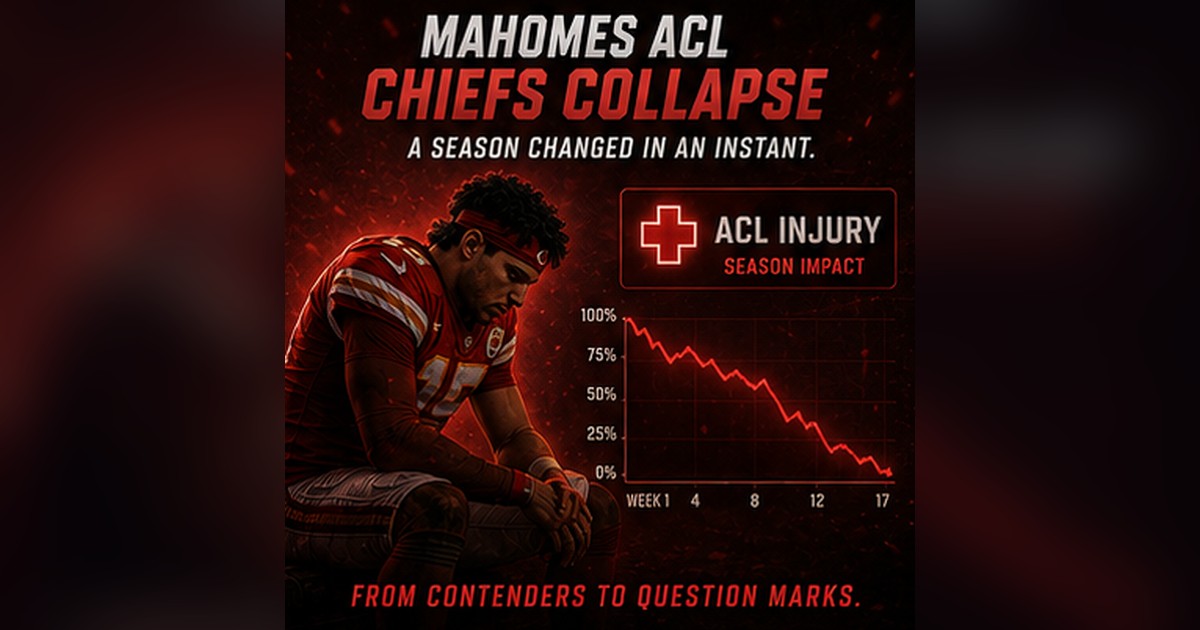
- The Patrick Mahomes ACL injury is a multi-ligament tear, not a clean one. He tore the ACL and the LCL in his left knee on Sunday against the Chargers and had surgery Monday night.
- Championship week just got rearranged for thousands of fantasy rosters. If Mahomes was your QB1, you are streaming in the title game, and every Chief who catches passes drops a tier with him.
- Kansas City has not missed the postseason since 2014. That streak is in genuine trouble, and the Chiefs are now a team in freefall rather than a team having a down year.
- Survivor pools lose their oldest safety blanket. KC has been the default "save it for later" pick for most of a decade. That entry in your notes app is dead.
- Pick'em players should expect the market to overcorrect. Names move lines harder than backups do, and the next three weeks of Kansas City spreads are where the value hides.
Patrick Mahomes tore the ACL and the LCL in his left knee on Sunday, December 14, in Kansas City's Week 15 game against the Chargers. He had surgery the following night. That is the whole story, and it is enough to reorganize the rest of the NFL season, the AFC bracket, and quite a lot of your fantasy football league.
There is no soft way to write this next part. This is the week a huge share of fantasy leagues play their semifinals and a bigger share of dynasty owners find out what their franchise is actually worth. It is also the week a lot of pick'em players discover how much of their season-long strategy quietly rested on the assumption that Kansas City would be favored in December.
So let's do the useful thing rather than the mournful thing. Here is what the injury means medically, what it means for your title game this week, and what it means for the pools we all actually play in.
What the Patrick Mahomes ACL injury actually is
An isolated ACL tear is, at this point, an unfortunate but well-understood problem. Surgeons do thousands of them. Timelines are published. Quarterbacks have come back from them and been fine.
This is not that. The LCL is the ligament on the outside of the knee, and when it goes with the ACL, you are no longer talking about a single reconstruction with a tidy rehab calendar. Multi-ligament knees involve more structures, more caution, and more variables that nobody can forecast in December. The ACL is the headline. The LCL is the part that turns a straightforward recovery timeline into a shrug.
The surgery happening the very next night is worth noting on its own. Teams often wait on swelling before operating. Moving that fast usually signals a plan that was made quickly and confidently, and it starts the clock as early as possible. That is the one genuinely encouraging detail available right now.
What we are not going to do here is put a return date on it. Anyone giving you a specific month for a multi-ligament knee three days after surgery is guessing with extra syllables. The honest answer is that this is a long one, and the next real information will come from Kansas City, not from the internet.
Fantasy championship week triage
If you are reading this with a semifinal or a final on the line, you already know the shape of the problem. Let's be practical.
- If Mahomes was your starter, you are streaming. There is no version of this where you hold a roster spot for a quarterback who has had knee surgery. Cut him for whatever the best available arm is on your wire, and do it before your leaguemates finish reading the news.
- Kansas City pass-catchers move down, not off. A backup quarterback still throws the ball. But the ceiling that made those players startable in a championship week is gone, and ceiling is the only thing that matters when you need to beat one specific opponent.
- The Chiefs' run game is the one piece that might benefit. Teams protecting a new quarterback tend to lean on the ground and shorten the game. That is a floor play, not a league-winner, but floor plays win titles too.
- Do not chase the panic. The waiver run on Kansas City's backup will be ugly. If you are not desperate, let someone else spend the budget.
This is also a reminder of how the entire quarterback position has behaved this year. The people who spent premium capital on quarterbacks have mostly been beaten by the people who waited, and we said as much back in our late-round quarterback piece in early September. The waiting strategy has one more argument in its favor now, and it is a grim one: the cheaper your quarterback, the less a single knee costs you.
Every fantasy season eventually teaches the same lesson in a new way. You do not draft players, you draft exposure to outcomes, and the outcomes you cannot model are the ones that decide your league.
The Chiefs are not having a down year anymore
Kansas City was already limping before Sunday. This has been a season of narrow losses, ugly offensive stretches, and a team that never found the gear it has always found in November. There was still a version of the story where the Chiefs shook it off in the last month, because that is what they have always done.
That version is gone. A team in a hole does not climb out of it with a quarterback change in Week 16. Kansas City has made the playoffs every single season since 2014, which is long enough that an entire cohort of fans has never watched a January without them. The streak is not mathematically over as of this writing, but it is now leaning on outcomes the Chiefs do not control.
The wider effect is on the AFC. Denver and New England have been the class of the conference all season, Jacksonville has been the year's best surprise, and none of them have to plan around a January trip to Arrowhead anymore. The single biggest structural fact of the last decade of AFC football has been removed from the board with three weeks left.
The survivor angle: KC was everyone's safety net
Survivor players plan the season in advance. You map the weeks, you spot the games where a good team gets a bad opponent, and you pencil in the teams you trust. For roughly ten years, Kansas City has been the most penciled-in name in the format, usually saved for a late week when the well runs dry.
Anyone still alive who was holding KC for Week 16, 17, or 18 now has to redraw the last stretch of their season on three days' notice. That matters more than usual this year because the field has been slaughtered. Thanksgiving alone wiped out 94.5% of the remaining Circa Survivor field when the Lions, Chiefs and Ravens all lost and the Bears upset the Eagles. Then Week 14 took another 62% when the Saints beat the Buccaneers 24-20, and the contest came down to ten entries chasing $18.7 million.
If you are one of the survivors reading this, the practical lesson is the one this season has been screaming since Week 2: your remaining-team inventory is a real constraint, and a single injury can delete a week you thought was solved. Build your last three weeks around teams whose value comes from the roster, not from one player.
The pick'em angle: fading the overcorrection
Here is where it gets interesting for anyone playing against the spread. Quarterback injuries are the most aggressively priced events in football. Markets move fast and they move far, because the name on the jersey is the thing casual money reacts to. A backup quarterback almost always gets punished by more points than his actual play deserves.
That does not mean you should be blindly backing Kansas City. It means you should be watching how far the line moves and asking whether the number reflects the roster or the headline. A few things to hold onto over the last three weeks:
- Defenses do not tear ligaments. Whatever Kansas City's defense has been all year, it is the same unit next Sunday.
- Game scripts change more than talent does. Expect shorter games, more runs, fewer possessions. That pushes totals down and keeps margins tighter than the pregame narrative suggests.
- Motivation is a real variable in Weeks 17 and 18. A team playing out the string against a team fighting for seeding is a spot the spread rarely captures well.
- Straight-up pools are a different game than spread pools. If your pool is confidence-weighted, this is the moment to stop assigning big numbers to Kansas City games in either direction. Uncertainty belongs in the middle of your ladder.
If you want to see how your pool's crowd is reacting before you commit, that is exactly what the picks page is for. The consensus tells you where the overcorrection is happening. Your job is to decide whether to ride it or take the other side.
What to watch over the next three weeks
The immediate questions are small and specific: who takes the snaps, how much the offense gets simplified, and whether Kansas City's defense decides to carry a team that no longer has an escape hatch. The bigger question is one nobody can answer in December, and it is about how a quarterback comes back from a knee that had two ligaments repaired at once.
For now, everyone playing pools has homework. Recheck your survivor inventory. Recheck your confidence ladder. And if you have a fantasy title game this week, go get the best available quarterback before the person you are playing does. The season did not end on Sunday, it just stopped being predictable, and the last three weeks are going to reward whoever adjusts fastest.