Key takeaways
- Week 14 survivor took the field from roughly two dozen entries down to 10. The Saints beat the Buccaneers 24-20 and wiped out 62% of everyone who was still alive.
- Ten entries remain in a contest that started with an $18.7 million prize. After thirteen weeks of carnage, one more bad Sunday could end it entirely.
- Survivor strategy fully inverts at this stage. Win probability stops being the objective. Differentiating from nine other people becomes the objective.
- Tampa Bay was the kind of pick that has been killing this field all year. A recognizable favorite in a divisional game, taken by most of the room because it looked like the tidy option.
- Fantasy playoffs start now. Whatever your league's format, the next three weeks decide the season, and the roster decisions you make this week matter more than every waiver claim you made in October combined.
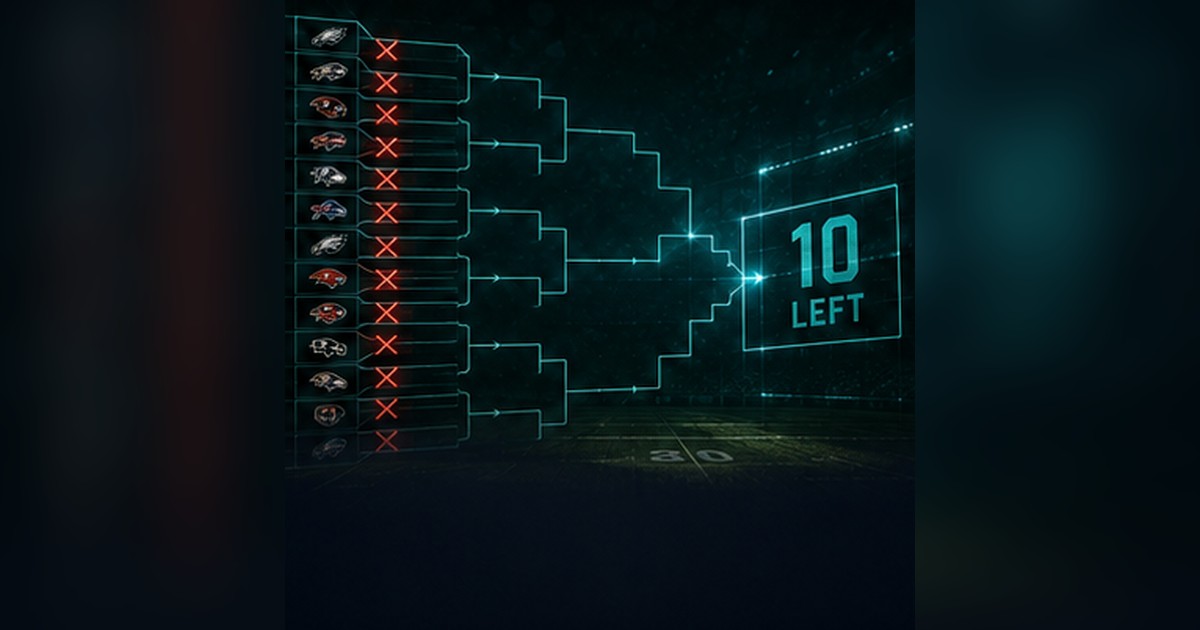
Week 14 survivor pools ended the season for almost everyone still playing. The Saints beat the Buccaneers 24-20, and 62% of the remaining Circa Survivor field went out with them. What is left is 10 entries. Ten. In a contest that opened with an $18.7 million prize pool and thousands of entries, we are down to a number you could fit around a dinner table.
It is a fitting way for this particular season to arrive at its endgame. Nothing about 2025 has rewarded the safe pick. Thanksgiving week alone eliminated 94.5% of the field, and Week 14 came along a week later and took 62% of the leftovers.
So let's talk about two things: what the final ten are actually playing now, because it is a genuinely different game than the one they started in September, and what the rest of us should be doing as the fantasy playoffs open.
How Week 14 survivor came down to ten entries
The Buccaneers were the popular side. Of course they were. A home-ish divisional matchup against a team nobody was scared of, a familiar brand, a number that looked comfortable. That is the exact profile that has been detonating this pool since September.
New Orleans won 24-20. A four-point game. Not a blowout, not a fluke, not a backup quarterback miracle — just a divisional opponent playing a divisional opponent close and finishing it. Which is, when you think about it, the least surprising thing in football and somehow still the thing that kills survivor pools every single year.
Nobody goes out of a survivor pool on a 30-point upset. They go out on a four-point game they never thought to worry about.
Sixty-two percent of the survivors were on it. That is the correlation problem in its purest form: when the entire room agrees on which game is safe, the room loses together. It happened in Week 5 when the Rams took 54% of the field down with them, it happened at Thanksgiving, and it happened again in Week 14. Three times is a pattern. Six times is a law.
The endgame: when survivor strategy inverts
Here is the part that most people never get to experience, so it is worth spelling out. Survivor strategy at 5,000 entries and survivor strategy at 10 entries are opposite games.
Early on, your objective is simple: do not die. Take the highest win probability you can afford given your future-week plan, because the field is enormous and gaining ground on it is meaningless. You cannot out-pick 5,000 people. You can only outlast them.
At 10 entries, that logic collapses. Now every other entry is a specific, identifiable competitor whose pick you can reason about. The objective is no longer survival. It is survival that other people do not share.
- If you take the same team as the other nine and it wins, you have gained nothing. Ten entries become ten entries. You spent a team off your inventory for zero equity.
- If you take the same team and it loses, everyone dies at once and you have handed the contest to whatever tiebreak or rollover rule the pool uses.
- If you take a different team and both win, still nothing changes — but you have preserved optionality, because your remaining team pool now looks different from theirs.
- If you take a different team and theirs loses, you have won the contest. That single branch is worth more than all the others combined.
Which means the correct play at this stage is frequently to take the second or third best team on the board rather than the obvious one. You are not maximizing your odds of surviving Sunday. You are maximizing the odds that you survive a Sunday somebody else does not. Those are different math problems and people confuse them constantly.
The inventory question. At this stage the binding constraint is not this week's board — it is which teams you have left and how many weeks remain. An entry with six unused contenders is in a wildly better position than an entry that has to thread three weeks with nothing but bad teams. If you are ever going to burn a great team on a mediocre spot, it is now, because there is no "later" left to save for.
What the final ten are really playing for
The other thing that changes in the endgame is that the pool stops being purely a contest and starts being a negotiation. Small survivor fields tend to produce conversations about splitting, and the incentives are obvious once you do the arithmetic on a prize this size against a schedule that could easily take out every remaining entry on the same afternoon.
Whether these ten do anything like that is their business. But it explains something about behavior at the end of these pools that looks irrational from the outside. A player holding a strong team inventory has leverage; a player down to scraps does not. That asymmetry is the real reason to think about your future-week plan in September, not because of the picks themselves, but because your inventory is your bargaining position if it ever comes to that.
And if it does not come to that, the mathematically likely outcome is that the last ten get thinned again, probably soon. This season has not shown much appetite for letting anybody coast.
The fantasy angle: championship season starts now
While survivor pools were finishing their demolition, most fantasy leagues just flipped into the postseason. Depending on your format, this is either your first playoff round or the last chance to set your seed. Either way, the games that decide your season are the ones in front of you.
A few things I would hold onto for the run:
- Start volume, not narrative. The players who have been getting targets and touches all month are the players who will get them in Week 15. Do not bench a high-usage guy for a matchup-based dart throw because someone on a podcast liked the dart throw.
- The waiver wire is still live. Michael Wilson has been the add of the year and he was available for nothing in November. Injuries are still creating target vacuums every week — Daniel Jones tore his Achilles in Week 14 and Indianapolis has to reorganize around it. Somebody in that offense is about to get a lot more valuable.
- Do not overthink quarterback. The late-round approach we argued for back in September has aged extremely well. Matthew Stafford has been the top-scoring fantasy quarterback since Week 4 after three unremarkable openers, and he cost almost nothing in drafts. If you have a quarterback who is playing well right now, that is enough. Chasing upside at the position in December is how people lose semifinals.
- Check the actual matchup, not the seed. Playoff brackets produce weird pairings. The 5-seed that limped in on tiebreakers may have the healthier roster and the better schedule.
The pick'em angle for Week 15
For everyone playing weekly pick'em rather than survivor, December is when the edges get largest, and it has almost nothing to do with talent. It has to do with motivation and health.
Teams out of the race start evaluating young players. Teams locked into seeding start managing snaps. Teams fighting for a wild card play their starters into the ground. The market prices these things, but it prices them late, and the public keeps betting the version of each team it formed an opinion about in October. That is the gap.
The other lesson this season has hammered home is to respect the points. Carolina won in Green Bay as a 13-point dog in Week 9. Big favorites have been losing outright all year across every kind of pool. If a spread looks too good to be true in Week 15, the 2025 season has given you thirteen separate reasons to assume it is.
Get your card in, look at where you actually sit, and remember that in a season this chaotic the standings can move four spots in a single Sunday.
What to watch the rest of December
Ten entries, a few weeks left, and a season that has spent every single week proving that the obvious pick is the dangerous one. If you had told anyone in September that the survivor field would be in single digits by mid-December, they would have assumed the pool started small.
For the rest of us, the assignment is simpler and just as unforgiving. Three weeks of fantasy football decide who was right about a five-month season. Play the volume, trust the usage, take the points, and try to enjoy the fact that this is the most unpredictable NFL season any of us have had to handicap in a long while.
See you next week, when something else improbable happens.